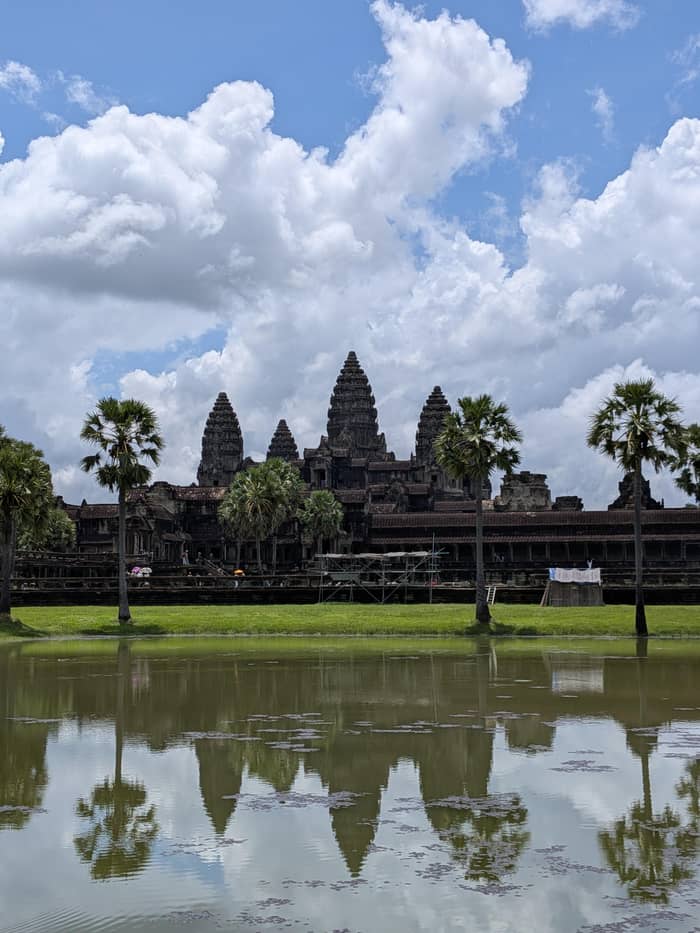
Small group
Small group of 14
Dress and bring list
- Dress noteKnees and shoulders covered
- Group sizeUp to 14
- Pricefrom $19
Guides
Language
Currency
See what is open$15 and up · free cancelTick-off checklist
Your list · 12 items
Mark items as done. Your progress is saved on this device only.
0 / 12 ready
Everything is ready. Only your date and your pickup hotel are left to choose.
Claim a spotCovered shoulders and knees, no hats at the temple, shoes for stone steps and a short list of what to carry and what the camera rules allow, all taken from the official visitor code.
Editorial team, angkorsunsettour.click · Updated November 23, 2026 · 9 mins to read
Essentials
The Angkor Wat dress code is written into the visitor code of conduct that Angkor Enterprise, the official pass seller, publishes. It rules out shorts, skirts that stop above the knee and uncovered shoulders in sacred places, and it strongly encourages respectful dress everywhere in Angkor.1 APSARA, the national authority, frames the code the same way: Angkor is a sacred site, so be considerate of worshippers and monks, wear appropriate clothing and do not touch or climb.5
The Angkor Wat page of APSARA adds a short note to the rule: hats are forbidden, and decent clothes are requested.2 The page does not say where the hat ban begins, so ask your guide where to take the hat off, and carry it in a bag instead of wearing it along the walls. A cap that stays in the vehicle for the hour inside costs nothing and avoids an awkward conversation at the gate.
Tour operators repeat the rule in their notes. A full-day listing asks guests to cover knees and shoulders when visiting temples, another describes the dress code as smart casual with shoulders and knees covered, and a further one states that shorts are not allowed. None of them asks for formal clothes, only for cover, so light trousers and a shirt with sleeves satisfy every note quoted here. Read the notes of your own booking too, because an operator can set a rule stricter than the park's.
The rules at a glance
| Item | Status | What the source says |
|---|---|---|
| Shorts and short skirts | Prohibited | Above the knees, in sacred places.1 |
| Bare shoulders | Prohibited | Respectful dress is strongly encouraged.1 |
| Hats at Angkor Wat | Forbidden | The temple page forbids hats.2 |
| High heels, backpacks, tripods | Discouraged | Inside the temples.3 |
| Smoking | Not allowed | A smoke free site since 2012.9 |
| Photos for personal memories | No permission needed | Business and film photography need it.4,10 |
Statuses follow the visitor code of conduct, the APSARA temple page and its spokesperson.5
In practice the rule means long trousers or a calf-length skirt with a top that has sleeves. Natural, quick-drying fabric copes with the heat, and a thin overshirt or a scarf covers the shoulders when a sleeveless top is the only thing that feels bearable. Loose cuts move better on the stone steps, and a long skirt that is too narrow turns a staircase into a problem. Choose fabrics that dry fast after a sweaty walk, since the gate is only the start of a long day outdoors.
Shoes matter more than most visitors expect. The visitor code discourages high heels inside the temples,3 and tour listings recommend comfortable walking shoes. The ground is stone, uneven and often dusty, and the hill at Phnom Bakheng is a slope that the authority has fitted with direction signs.8 Closed shoes with a grip suit the evening better than sandals that slide off. Pack a spare pair of socks if you wear closed shoes, because a day of heat and dust is hard on feet.
Think about the layers you can take off at the end. A light cover-up that goes over a vest top works for a temple visit, and it can sit in a bag while you walk between temples. Leave pale clothes at the hotel, since dust and the late sun show every mark on them, and put the hat in the bag too, remembering the ban at Angkor Wat itself.2 The same cover-up serves again at the gate of any other temple you add to the day, since the code applies across Angkor and not only at Angkor Wat.1
Dressing the day
At the hotel
Shoulders and knees covered, closed shoes on.1
At pickup
The full-day sunset listing has a pickup that starts at 9:10 AM and ends at 9:30 AM.
At the gate
Hats are forbidden at Angkor Wat.2
In the temple
On the hill
Direction signs and fence posts mark the way.8
Back at the hotel
That listing expects the hotel return some time from 6:30 PM until 7:00 PM.
A listing for a small-group day with a sunset names the items it wants guests to bring: a camera, sunscreen, sunglasses and insect repellent. Another listing puts insect spray on its list as well. Add a refillable water bottle and a small amount of cash, and you have the kit that almost every sunset day asks for, whatever the operator. If you take photographs, a spare battery and a lens cloth earn their place in the same bag.
The code advises leaving backpacks, sharp-tipped umbrellas, tripods and heels outside the temples,3 so a light cross-body bag is a better choice than a rucksack. The pass is the item you cannot forget: the Angkor Temples Park 1 day pass costs $37,12 and the small-group listing sold on this site does not include it. A small waterproof pouch protects the phone and the pass from sweat and from a sudden shower.
Smoking is not allowed at Angkor, a smoke free site since 2012,9 and APSARA asks visitors to take their litter with them.5 The visitor code also asks you not to give candy or money to children, because it encourages them not to attend school but to beg, and it suggests donating to a recognised charity instead.13 Pack a small bag for rubbish and decide your charity before the day starts. Decide what you will do with snack wrappers, because litter is carried out and not left behind.5
Outfit check
Name your problem and the answer follows.
If I am wearing shorts today
Change before the gate
Shorts are named as prohibited in sacred places.1
If My top has no sleeves
Add a scarf or shirt
Bare shoulders are prohibited.1
If I wear a hat against the sun
Carry it in a bag
The Angkor Wat page forbids hats.2
If I like to use a tripod
Leave it in the vehicle
Tripods are discouraged inside the temples.3
If I want a photo of a monk
Ask permission first
The visitor code asks for permission before the picture.11
Tours that name the dress code
Small group
Dress and bring list
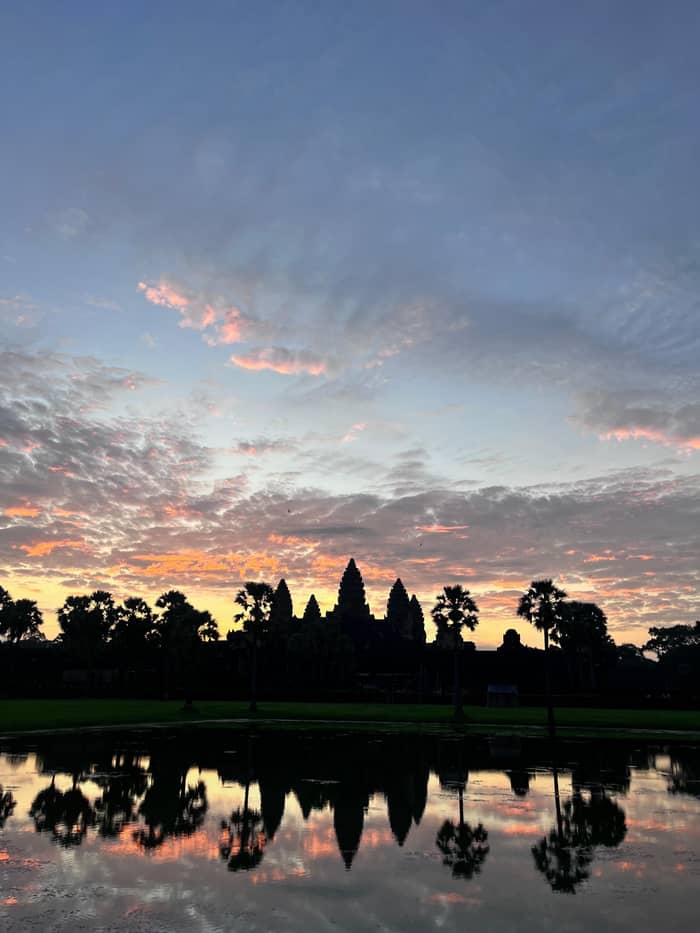
Full day
Shoulders and knees covered
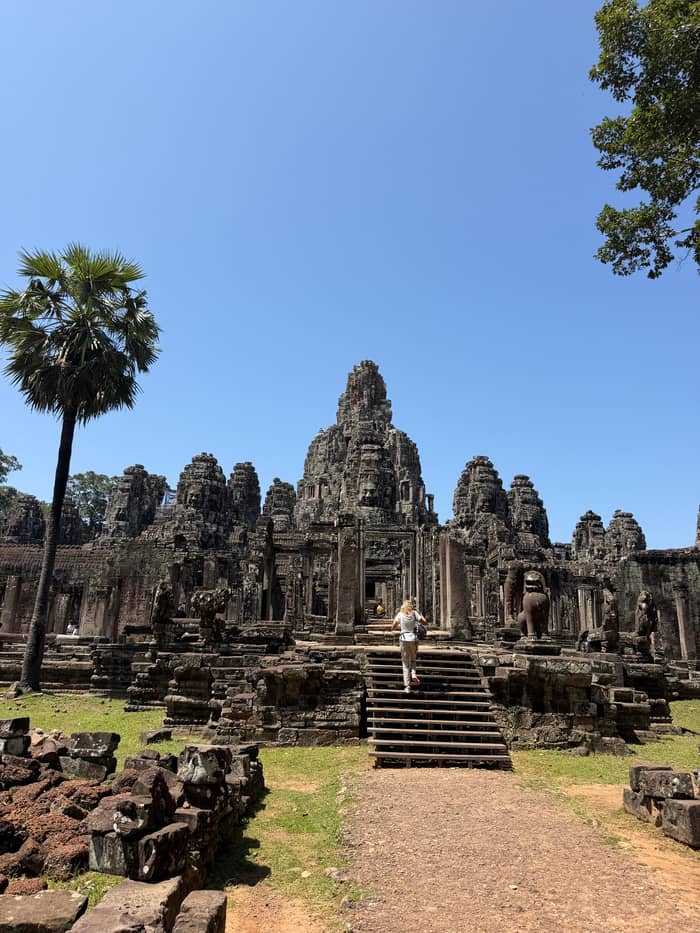
Multi-day
Respectful dress note
The code treats noise as a form of disrespect. It says loud conversation and noise are considered offensive in Cambodian culture at a sacred site and may disturb other visitors, and it asks everyone to stay calm and respectful.14 At sunset that matters, because a crowd gathers on a hilltop and a loud group changes the feel of the place for everyone near it. Think of the quiet as part of the dress code: both show respect to a place of worship that has been in use since its foundation.16
Touching is another theme. The code strictly prohibits touching carvings, sitting on fragile structures, leaning on temple structures, taking archaeological artifacts and graffiti.7 It also asks visitors to comply with all signs, to be mindful of their steps and not to climb on loose stones.6 For a photographer, that means no leaning on a wall to steady a shot and no stepping over a rope for a better angle.
Monks are a further subject. The code says monks are revered and respected, that visitors who want to take their picture should ask permission first, and that women should not touch nor stand or sit too close to monks.11 If a monk is part of the scene you want to photograph, a polite question first is the rule, and a refusal is final. A monk who agrees to a picture is giving something, so thank him and do not follow him with the lens.
Plan the cost
Fill in the party size to see the listings side by side.
Compare all 3 options
Fill in the party size to see the listings side by side.
≈
View≈
View≈
ViewFrom-prices on GetYourGuide, shown at the ECB reference rate. Your exact price is confirmed during booking.
Some of the sunset places have rules about who goes to the top. For safety, APSARA does not let children under 12 or pregnant women onto the top of the Angkor Wat pyramid.15 The same restriction applies at Phnom Bakheng, the hill used for sunset views.17 Plan the evening so that anyone who stays below still has a good place to be. Children under 12 and pregnant visitors can still enjoy the approach, the moat and the galleries from below.15
A sunset listing adds an age rule of its own: it does not permit children aged 7 and under. Operators set such rules on top of the park's, so ask the operator at booking when a young child is in the group. A full-day listing notes that younger children do not need a temple ticket, which helps with the budget but does not change the safety rules at the top. Ask the operator before you book, not at the meeting point.
Bakan, the upper level of Angkor Wat, is open from 7:40 am and shuts at 5:00 pm, staying closed on Holy days.18 If the central sanctuary is on your list, go before the evening and keep the golden hour for a hill or a lake. APSARA's authority has prepared a walkway and signs at Phnom Bakheng and asks guides to follow the arranged route, so follow your guide there.8 Whatever your plan, leave a margin for the walk back down in fading light.
Video
Window Seat on YouTube · Tap play to load the video; not before.
Respect all temples by being considerate of worshipers and monks, wearing appropriate clothing, not touching or climbing, and taking litter with you and not giving money to children.
The camera rules are simple on paper. APSARA's spokesperson confirmed that taking photos and videos of personal memories does not require prior permission.4 Pre-wedding photography, YouTube, live recordings as a guide, filmmaking, music videos and photography for business purposes do require prior permission.10 A traveler with a phone or a camera for the family album is on the permitted side.
Photography at Angkor Wat at sunset has its own habits. For a reflection of the towers, APSARA points to the northern pond,19 and the lions at Sras Srang give photographers a frame.20 Tripods are discouraged inside the temples,3 so travel with a monopod or a small clamp, and keep your elbows to yourself in a crowd. Monopods are not named in the code, so ask a guide before you rely on one.
Ask first when people are part of the picture. The code asks visitors to request permission before photographing a monk,11 and the same courtesy suits villagers, guides and anyone at prayer. A photograph is easier to take when you have asked, and a smile and a nod usually settle the question without a word of the local language, while a refusal is simply accepted. It is a courtesy that costs nothing and leaves everyone happy with the result.
A handful of Angkor Wat tips cover most evenings. Check the closing time of the temple you plan to stand in against the sunset of your month, because Angkor Wat lists 5:30 pm and the sun can go down just after it.18,21 Bring the pass and a small bag, keep water within reach and follow the signs on the hill. Decide in advance whether the last hour belongs to the temple or to a hill, and tell your guide, since the schedule follows from that choice.
Know your pickup rhythm. The full-day listing with a sunset starts with a pickup from 9:10 AM until 9:30 AM and ends with hotel arrival at some point from 6:30 PM until 7:00 PM, which makes for a long day in covered clothes. A small-group listing needs the pass bought before the tour starts, so settle the ticket the day before. Pickup times differ between listings, so read your own booking rather than a general guide.
Finally, plan the end of the day too. After a long, dusty day in covered clothes, a clean shirt waiting in the vehicle makes the drive back more pleasant. The sunset is the easy part of the evening, and an outfit chosen well for the gate is what lets you stay out for the whole of it without a worry about being turned away. Keep the pass, the camera and the water together in one bag so that a quick change takes minutes and not an hour.
FAQ
The code bans shorts, skirts that end above the knee and bare shoulders in sacred places.1
APSARA's Angkor Wat page says hats are forbidden and decent clothes are requested.2
The code names shorts and skirts above the knees as prohibited there, and listings repeat the rule.1
Listings recommend comfortable walking shoes, and the code discourages high heels.3
The code names no age, and a full-day listing says children under 12 need no ticket.1
The code describes Angkor as smoke free since 2012.9
The visitor code asks anyone who wants a picture of a monk to ask permission first.11
Sources
Planning a dawn or dusk at the towers? Ask a real person here.