Small group
Small-group day
The tour sold here
- Time at the temple3 hours
- GuideLive, in English
- Pricefrom $15
Guides
Language
Currency
See what is open$15 and up · free cancelPrice for your party
Compare all 3 options
Set your party size and weigh the guided days that spend time at Angkor Wat.
≈
View≈
View≈
ViewFrom-prices on GetYourGuide, shown at the ECB reference rate. Your exact price is confirmed during booking.
From a royal temple of Vishnu in the early 12th century to a Buddhist pilgrimage site and a World Heritage monument: what the official sources say about the original plan, its west-facing layout and its age.
Editorial team, angkorsunsettour.click · Updated November 23, 2026 · 8 mins to read
Essentials
Angkor Wat was a royal project from the start. According to APSARA, the national authority that looks after Angkor, Suryavarman II had the temple raised between 1113 and 1150 to serve as his state temple and as the core of his capital.1 Angkor Enterprise, the official pass seller, places it in the early 12th century,7 and APSARA sets it at the south-eastern edge of Yashodhara, the city that Yashovarman I centred on Phnom Bakheng.8
The temple had a double purpose. In APSARA's account the building was a home for Vishnu and also a divine palace that waited for the king in the afterlife.9 APSARA's estimate for the work is some 30 years of heavy labor,10 and it places the temple in the royal Temple-Mountain line of Khmer building, with a position of its own.11 Angkor Enterprise adds that it was meant as his state temple and eventual mausoleum.12
People often ask how old Angkor Wat really is, and the sources answer with dates, not with a single figure. The temple is younger than Phnom Bakheng, dedicated about 907, and than Pre Rup, consecrated in 961,13,14 and it is older than the Bayon, a temple of the late 12th or early 13th century.15 The age of Angkor Wat is easiest to read as a position in a sequence of temples. The table further down sets the dates of the neighbours side by side.
What was built when
| Place | Date | What the source says |
|---|---|---|
| Phnom Krom | Late 9th and early 10th centuries | An ancient temple on the hill.25 |
| Phnom Bakheng | About 907 | State temple of the first city at Angkor.13 |
| Pre Rup | 961 | Founded under King Rajendravarman.26 |
| Angkor Wat | 1113 to 1150 | State temple of Suryavarman II.1 |
| Sras Srang | Around 1200 | Royal bath modeled by Jayavarman VII.27 |
| The Bayon | Late 12th or early 13th century | State temple of Jayavarman VII.15 |
Dates are the ones the authorities give on their temple pages; scholars may differ on the exact years.5
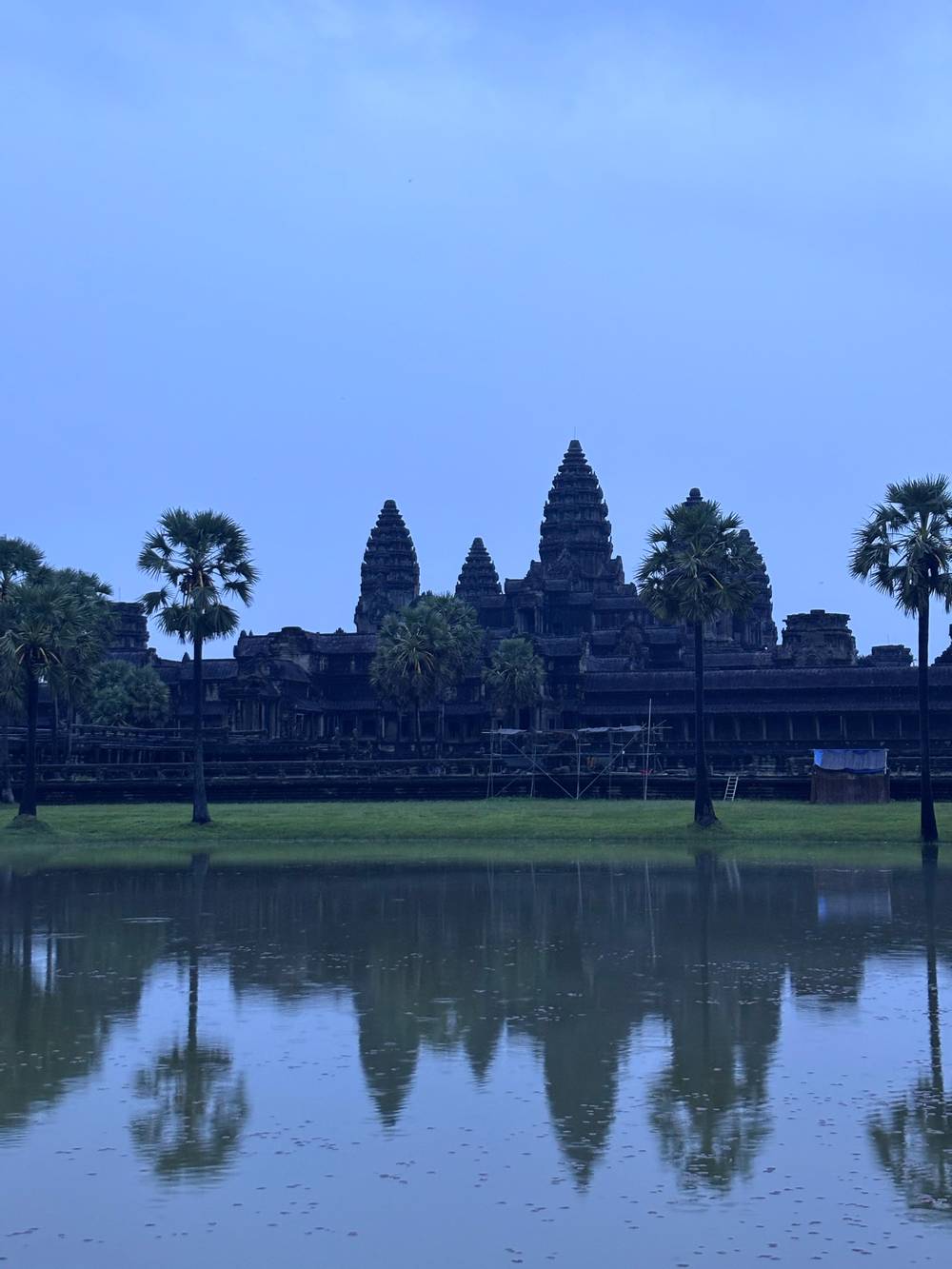
The question of what Angkor Wat looked like originally has a partly stone-written answer, because the plan survives. The design is a model of Mount Meru, in Angkor Enterprise's words, with galleries stepping upward inside a moat and a wall 3.6 kilometres long, and a quincunx of towers rising in the middle.19,20 A sandstone causeway of 200 metres bridges the moat on the west, while a plain bank of earth serves the east.21 That is the frame the later changes were made inside.
The heart of the temple looked different. The sanctuary on the top terrace had openings toward the cardinal points, and APSARA thinks a statue of Vishnu probably stood inside.3 When archaeologists opened the southern doorway in 1908, no original Vishnu statue turned up, only statue and pedestal fragments and a sarcophagus.16 Deep in the sanctuary well, at a depth of 23 meters, a laterite block held circular gold leaves, which APSARA identifies as the original foundation deposits.22
The carved walls date from the same age. APSARA says the friezes were, for the most part, executed during, or shortly after, the reign of Suryavarman II.23 Only the northeastern corner of the galleries was left bare at that time and was carved in the 16th century, in a style that APSARA calls notably inferior to the earlier work.24 The official pages describe the shapes and the carving, and they do not describe paint or gilding, so this page does not either.
Key dates
About 907
Phnom Bakheng is dedicated at the core of the first city.13
1113 to 1150
Suryavarman II has his state temple and capital raised.1
16th century
The temple becomes a significant Buddhist pilgrimage site.2
1908
Archaeologists open the southern entranceway of the central sanctuary.16
1992
Angkor Wat is classed as UNESCO World Heritage in December.17
2004
Angkor leaves the List of World Heritage in Danger.18
Most Angkorian temples do not face west, and Angkor Wat does. Angkor Enterprise says that, unlike most Angkorian temples, Angkor Wat is oriented to the west, and that scholars are divided as to the significance of this.5 That honest line is worth keeping in mind whenever a guide gives you one confident reason for the orientation. Why Angkor Wat faces west remains an open question.
APSARA offers the reading most often repeated. The westward orientation is opposite to the orientation of sanctuaries dedicated to divinities, and in Brahmanic funerary rituals the rites are performed in reverse of the normal order.4 As a result, APSARA explains, the carved galleries are read counter-clockwise.30 The funerary reading sits well beside the idea of a palace for a king after death, though nothing proves it.9
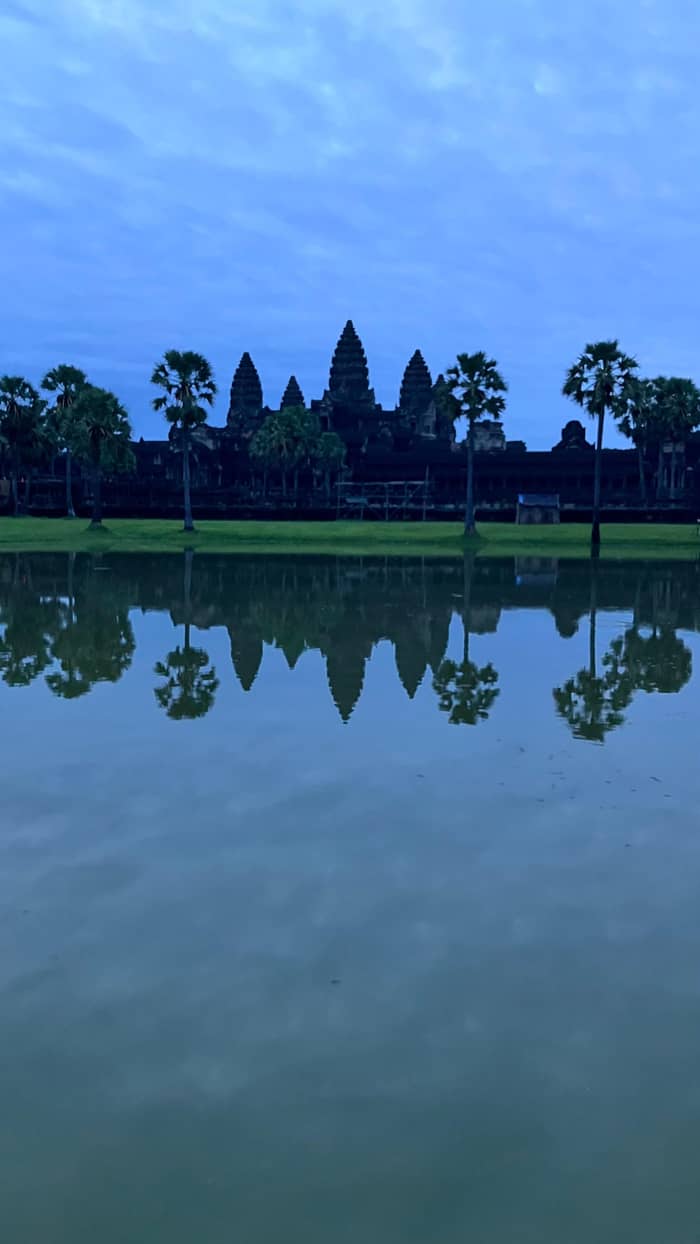
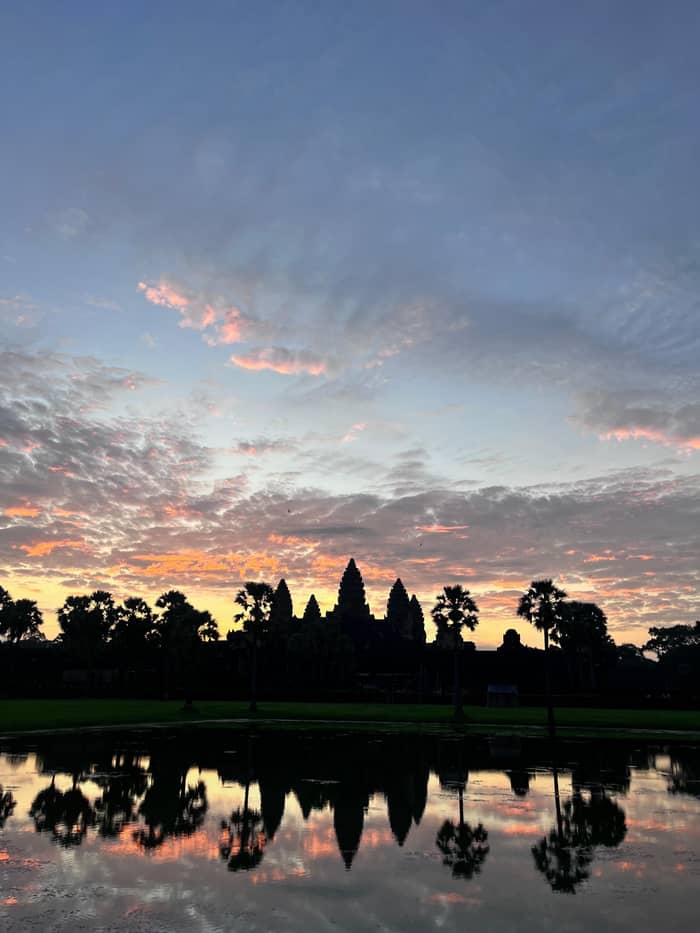
For a visitor the plan has a practical side, since the western front of the temple turns toward the evening sun. That is a pleasure for photographers, and it comes with a clock, because the listed closing time sits close to the sunset on some dates.31,32 Seeing the west face in the afternoon and taking the sunset from a hill is one way to solve the timing. The causeway itself, 200 metres of sandstone, is where the question is easiest to feel.21
Where to start
Choose the thread that interests you and a first question appears.
If I want to understand the west-facing plan
Ask at the causeway
APSARA ties it to funerary rites, and scholars are divided.4,5
If I want the original temple
The central sanctuary
Its doorways faced the cardinal points, and a statue of Vishnu probably stood inside.3
If I want the Buddhist chapter
Preah Poan
Pilgrims left most of the 41 inscriptions there.28
If I want the hidden treasure
The foundation deposit
Gold leaves lay at a depth of 23 meters.22
If I want the modern chapter
The 2003 head
The original head of the Ta Reach statue replaced a cement copy.29
The story with a guide
Small group
The tour sold here
Longer plan
Built around a 3-day pass
Full day
Angkor Wat for 2.5 hours
The temple changed faith without changing its importance. APSARA dates the Buddhist chapter to the 16th century, when a shrine that began for Vishnu turned into an important place of pilgrimage for Buddhists.2 Its Middle Period name, Preah Pisnulok, recalls the posthumous title of the founder, and the visitors came from much of Southeast Asia.38 APSARA also records that the name Angkor Wat means Buddhist Monastery in the city.39
The change left marks on the building. Sandstone blocks closed the doorways of the central sanctuary, and each new wall received a standing Buddha in deep relief,33 and APSARA reads the work as the transformation of a Brahmanic sanctuary into a Buddhist stupa.40 Over time worshippers filled the cross-shaped gallery of Preah Poan with Buddha images, and that is where most of the temple's 41 Middle Period inscriptions are found.34,28
A popular story has Angkor Wat abandoned and swallowed by jungle. The official sources tell a different one. The pilgrims' inscriptions point the other way from abandonment, and Angkor Enterprise says the best-preserved temple of the site is the only one that has stayed a significant religious centre from its foundation onward.6 Beyond the park, the temple stands for the nation: it appears on the flag of Cambodia.41
Modern work began early. UNESCO dates the conservation and restoration works at Angkor from 1907 to 1992 and judges that they did not significantly change the authenticity of the monuments.42 The Ta Reach statue at the west gate shows the care taken: a cement copy of its head gave way in 2003 to the original, kept in the meantime at the National Museum of Cambodia.29 Today, APSARA says, the Khmer people see in Little Angkor, the familiar name of the temple, the symbol of their nation.43
The international frame came next. APSARA says that since December 1992 Angkor Wat and the other Angkorian monuments have been classed as UNESCO World Heritage,17 and UNESCO lists the inscription of Angkor in 1992, on a property of 40,100 ha.44 UNESCO adds that Angkor came off the danger list in 2004, which it presents as the crowning result of APSARA's conservation.18 The care of Angkor passed to APSARA through a Royal Decree adopted on 19 February 1995.45
The bodies that manage the site came together in those years. UNESCO says the international coordinating committee, ICC-Angkor, was created on 13 October 1993, and the Royal Decree that created APSARA was adopted on 19 February 1995.46,45 UNESCO adds that the Royal Decree on the zoning of the Siem Reap and Angkor region was adopted on 28 May 1994,47 and that ICC-Angkor coordinates the successive scientific, restoration and conservation projects of the government and its international partners.48
Video
Extra History on YouTube · Tap play to load the video; not before.
As the best-preserved temple at the site, it is the only one to have remained a significant religious centre since its foundation.
On the day
Angkor Wat is easier to place beside its neighbours. Phnom Bakheng was dedicated about 907 as the state temple of the first city in the core of Angkor,13 Pre Rup was founded in 961 by King Rajendravarman, who brought the capital back to Angkor from Koh Ker,26 and Jayavarman VII remodeled the Sras Srang royal bath about the year 1200.27 Dates alone do not make a story, but they make a useful ruler.
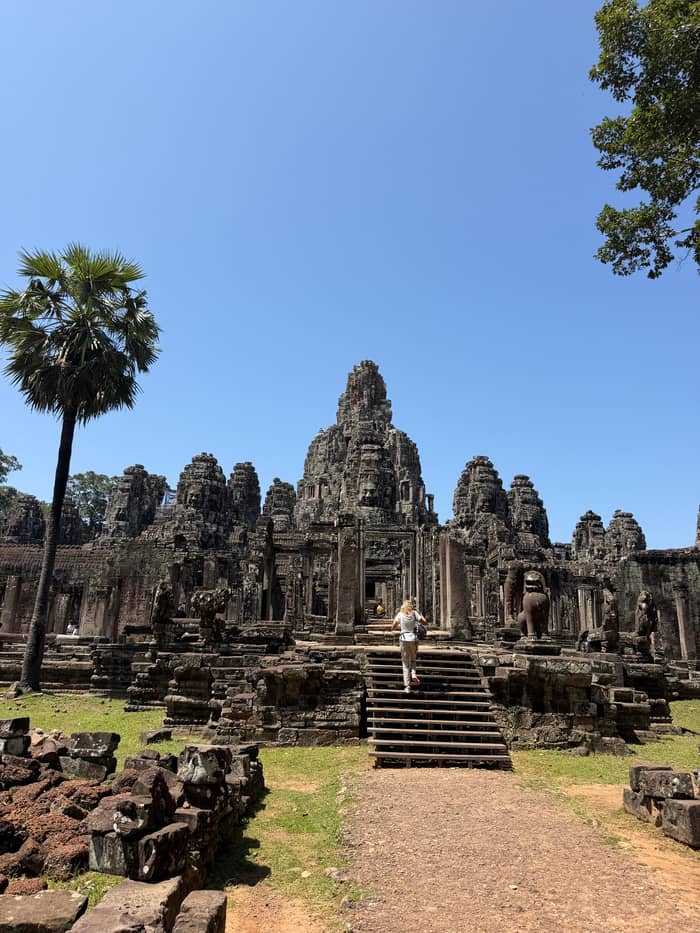
The Bayon, famous for its smiling stone faces, is a temple from the end of the 12th century or the start of the 13th, the state temple of Jayavarman VII,15,49 while Preah Khan was raised in the 12th century by the same king to honor his father.50 Phnom Krom, beside the Tonle Sap lake, carries an ancient temple dating from the 9th and 10th centuries.25 Phnom Bakheng is one of 3 hilltop temples in the Angkor region attributed to the reign of Yasovarman, and Phnom Krom is another.51
UNESCO's summary is broad: the Angkor complex covers the whole range of Khmer art over centuries, and Angkor Wat, the Bayon and Banteay Srei count among its masterpieces.52 Seen that way, the sunset hills and the temple are chapters of one story, and a guide who tells them in order gives the day a shape that a list of stops cannot. Angkor Wat itself lies about 1.5 km from Phnom Bakheng.53
A guide makes the history visible. Ask where the filled-in doorways of the central sanctuary are, which reliefs date from the 16th century and which were carved in the reign of Suryavarman II.33,24,23 Ask, too, why the reliefs are read anti-clockwise, and listen for whether the answer admits that scholars are divided.30,5 Few of these questions have a single answer, which is part of the interest.
The small-group day that this site sells spends 3 hours at Angkor Wat within 8 to 9 hours in all, from $15. A 2-day tour built around a 3-day pass gives the history more room, from $34. A live English-speaking guide takes each group. A longer plan gives the history room: sunrise on one day and sunset on another, with the 3-day pass covering both, and the itinerary of each listing deserves a read before you rely on a stop.
Whatever you book, buy the pass first and check the hours. The 1 day pass costs $37, and the temple page gives 5:00 am to 5:30 pm for the grounds.36,31 The central sanctuary keeps shorter hours and is shut on Holy days, which makes the highest level a morning visit.31 If you prefer to read about the temple beforehand, the description page on this site sets out its moat, galleries and central sanctuary in plain words.
FAQ
APSARA thinks a statue of Vishnu probably stood in a sanctuary that was open to the cardinal points.3
Suryavarman II raised it between 1113 and 1150 as his state temple and capital.1
Angkor Enterprise says it stayed a significant religious centre from its foundation, which sets it apart from the other temples at the site.6
APSARA places the change in the 16th century, when the temple became a significant pilgrimage site for Buddhists.2
UNESCO dates conservation and restoration works at Angkor from 1907 to 1992.42
Sources
Planning a dawn or dusk at the towers? Ask a real person here.